SMT vs. THT for PCB Assembly: Key Differences & Selection Guide
When you are quoting a PCB assembly job, the real question is usually not which method is “better.” It is which one fits your component mix, board layout, and test plan.
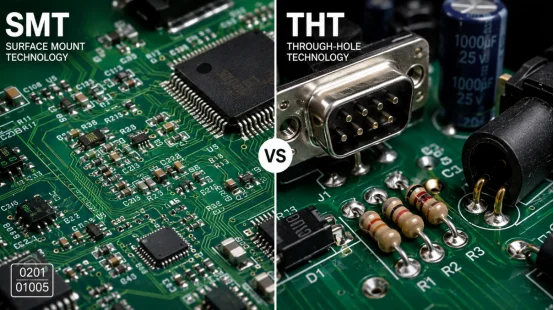
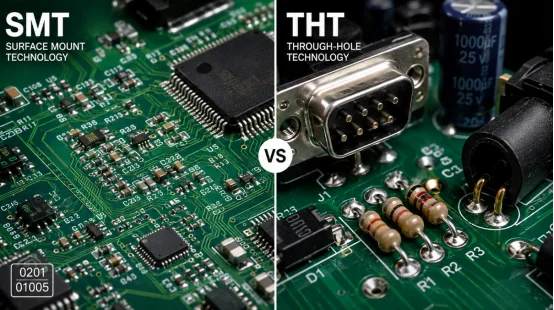
SMT vs. THT assembly is mostly about where the part sits and how it gets soldered. SMT puts parts on the surface. THT puts leads through holes. That simple split changes density, inspection, soldering flow, and even how you should write the RFQ.
What Do SMT And THT Mean?
SMT and THT solve different problems on the same board. SMT, or surface mount technology, places SMD parts directly on the PCB surface. SCSPCBA describes it as a standard choice for compact boards, including fine-pitch and small parts such as 01005 and 0201.
THT, or through-hole technology, uses drilled holes and component leads that pass through the board. That gives the joint more mechanical support. It is the usual fit for connectors, switches, and parts that take stress.
Surface Mount Technology (SMT)
SMT starts with solder paste on the pads, usually through a stencil. Parts are placed, then the board goes through reflow soldering. The process is fast and highly automated. It also supports component placement on both sides of the board, which is why it shows up so often in dense designs. For you, the practical point is simple. If space is tight, SMT usually gives you more room to work with.
Through-Hole Technology (THT)
THT uses pre-drilled holes, then insertion and soldering. SCSPCBA groups it with DIP assembly and through-hole assembly, and notes that it is often used for parts that need stronger mechanical attachment or higher current handling. It also fits older or mixed BOMs that still carry leaded parts. In real production, that usually means connectors, power devices, and a few parts that just do not belong on the surface.
Mixed Technology PCB Assembly
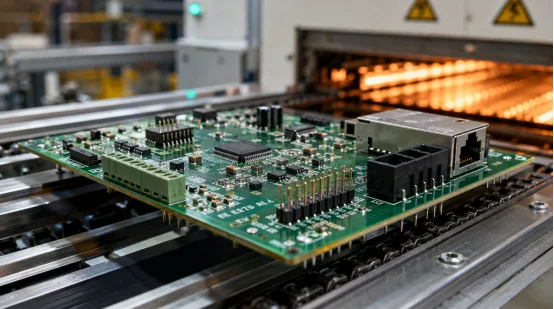
Mixed technology PCB assembly combines both methods on one board. That is common when a design needs SMT for density and THT for strength. The flow is usually SMT first, then through-hole insertion, then wave soldering, selective soldering, or hand soldering for the remaining joints. That is where project planning matters. A mixed board can be clean and efficient, but only if the process order is set early.
How Do They Differ In Real Production?
The differences show up fast once the board leaves the CAD file. SMT usually wins on density and automation. THT usually wins on mechanical hold and simple visual access.
Neither point is abstract once you are dealing with a production run and a schedule. The board has to be built, checked, and shipped. That is the part people miss when they only talk about component style.
Board Density And Component Type
SMT makes it easier to pack parts tightly and build smaller boards. It is also the better fit for modern high-density layouts. THT takes more space because the holes themselves consume area.
If your design has fine pitch parts, small passives, or both sides populated, SMT is usually the cleaner path. If the BOM includes bulky connectors or parts that will be pulled, plugged, or handled often, THT is the safer physical fit.
Mechanical Connection And Access
THT gives you a stronger mechanical bond because the leads pass through the board and are soldered in place. That matters for parts exposed to force. SMT is different. It is lighter and more compact, but the joint is built for surface attachment. Inspection can also feel different. THT joints are easier to see with the naked eye. SMT often depends more on AOI, X-Ray for hidden joints, and clean process control.
Inspection And Rework Visibility
SMT and THT do not ask for the same inspection mix. SMT usually needs solder paste control, placement checks, and post-reflow inspection. THT brings its own checks, especially if you are dealing with mixed lines or hand insertion.
SCSPCBA also calls out AOI, SPI, X-Ray, ICT, FCT, and first article inspection as part of the broader quality flow. That is not just shop-floor detail. It is where batch risk gets caught early.
What Does The Production Flow Look Like?
The process is different enough that you should think about it before you release the files. SMT usually means paste, placement, and reflow. THT means hole prep, insertion, and soldering. Mixed builds combine both, so the order and the soldering method matter. If the process map is vague, the quote will be vague too.
SMT Process
SMT usually begins with solder paste printing on a stencil. Parts are placed by machine, then the board goes through reflow soldering. SCSPCBA also mentions SPI before soldering and AOI after placement and reflow. That is the normal rhythm for a modern SMT line. It is quick, repeatable, and suited to volume work.
THT Process
THT starts with insertion into drilled holes. After that, the board may go through wave soldering, selective soldering, or hand soldering, depending on the part mix. Wave soldering fits many through-hole parts. Selective soldering is useful when only certain joints need heat. That is often the cleaner choice in mixed assemblies where not every hole should see the same soldering step.
Mixed Technology Flow
Mixed technology usually means SMT first, then THT. That sequence keeps the surface-mount side stable before the through-hole side is finished. It also gives you a better shot at controlling hidden risk on the mixed line. If the board carries both fine-pitch SMT and leaded parts, the process order is not a small detail. It is the difference between a smooth build and a messy one.
What Should You Put In Your RFQ?
If you want a useful quote, give the assembler enough detail to see the process, not just the BOM. State the component types, lead style, and which parts are SMT, THT, or mixed. Call out any hand soldering, fixture, or test requirement. If the board has connectors, power parts, or odd mechanical loads, say so early. That saves back-and-forth later.
For design handoff, a DFM review helps catch pad, hole, and soldering issues before the job starts. A first article inspection is just as useful when you want the first board checked against the BOM and placement data before the full run. For test-heavy builds, line up Testing & Inspection with the quote, not after it.
How Do You Choose The Right Mix?
Use the board, not the label, as the guide. If the design is dense, compact, and mostly surface parts, SMT is usually the first pick. If the BOM includes connectors, heavy leads, or parts that need a firmer hold, THT belongs in the plan. If both are true, mixed technology PCB assembly is the practical answer. That is normal, not awkward.
When The Job Needs Both Sides Done Well?
That is where a one-stop PCB assembly setup helps. SCSPCBA combines SMT assembly, DIP and through-hole assembly, mixed technology builds, double-sided reflow soldering, selective wave soldering, AOI, X-Ray, ICT, FCT, and MES traceability.
It also supports DFM review and first article inspection, which matters when the board has both fine-pitch SMT and leaded parts. In a mixed build, the process chain matters more than any single machine. See the PCBA service and the homepage for the broader service setup.
FAQ
Q1: Is SMT always better than THT?
A: No. SMT is better for density and automation, while THT is better for parts that need stronger mechanical support.
Q2: When should you choose mixed technology PCB assembly?
A: Choose it when one BOM needs both surface parts and leaded parts. That is common on connector-heavy or mechanically stressed boards.
Q3: What soldering method is used for THT?
A: Wave soldering is common, and selective soldering is often used when only part of the board needs soldering.
Q4: What should you send in an RFQ for PCB assembly?
A: Send the BOM, assembly file, component types, insertion needs, hand soldering needs, fixture needs, and test requirements.
Q5: What inspection steps matter most in SMT vs. THT assembly?
A: SMT usually depends on SPI, AOI, and sometimes X-Ray. THT often depends on visual checks, functional test, and first article inspection.





Leave a Reply
Want to join the discussion?Feel free to contribute!