PCBA Traceability Guide: Records, MES & Audit Checklist
A returned board arrives with a serial label. The supplier can find the shipment date, yet cannot show which component lot went into the board or which test result cleared it. That is where PCBA traceability either proves its value or falls apart.
Useful electronics manufacturing traceability connects materials, production steps, serial numbers or batches, inspection results, changes, and shipment records. A long spreadsheet is not enough. You need records that lead to each other, quickly and in both directions.
What Does PCBA Traceability Need to Connect?
A good traceability chain begins before assembly and continues after the finished boards leave the factory. Each link should identify what entered production, what happened on the line, and which products may share the same risk.
Material Identity and BOM Revision
Start with the approved BOM. BOM revision control should show the released version, approved substitutes, authorization status, and production orders that used it. This matters when two nearly identical components have different voltage ratings or temperature grades.
Material lot traceability should cover the PCB, electronic components, and relevant auxiliary materials. Incoming records may include the manufacturer part number, supplier, lot or date code, packaging condition, model verification, and inspection status. If one reel later becomes suspect, the supplier should be able to identify every affected board.
Process Route, Serial Number, and Shipment Links
The actual route should show whether the board completed solder paste printing, placement, reflow, inspection, insertion, testing, repair, and final release as required.
PCBA batch traceability links boards produced under shared conditions. PCB assembly serial number tracking goes further by connecting one finished unit to its material and process history. Both can be useful. The right depth depends on product risk, volume, customer requirements, and system setup.
Shipment records close the chain. You should be able to move from a shipped serial number back to production, or from a material lot forward to shipped products.
Which Records Should You Request from a Supplier?
A factory tour shows equipment. Records show what happened to your order. Ask for a completed example from a controlled build, with sensitive customer details removed if needed.
Production, Inspection, and Test Records
Incoming inspection should cover PCBs, components, auxiliary materials, BOM checks, and key material sampling. Production records may show the process route, equipment, time, operator, and status where the project calls for them.
PCBA test records should match the agreed quality plan. Depending on the board, these may include solder paste inspection, automated optical inspection, X-ray inspection, in-circuit testing, functional testing, aging tests, and outgoing checks. A one-stop PCBA service can connect sourcing, assembly, testing, and final delivery, but you still need to define the required coverage.
A test result in a database looks reassuring. It says little if the wrong test was run.
Nonconformance, Rework, and Change Records
When a board fails, its record should show the defect, disposition, repair action, secondary inspection, approval, and release status. This closes the loop and prevents repaired boards from quietly rejoining good stock.
Manufacturing change history should cover BOM changes, material substitutions, route changes, test-limit updates, and other approved deviations. Check who authorized the change, when it took effect, and which batches were affected.
How Do Barcodes and MES Support PCB Assembly?
Barcodes and manufacturing software reduce manual gaps, but only when data and scanning rules are maintained. They help connect events. They do not decide whether the process itself is suitable.
What the System Can Record
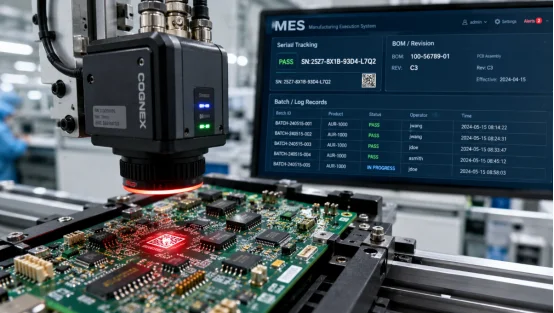
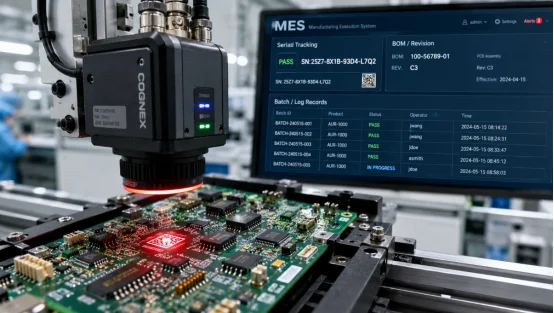
In an MES PCB assembly workflow, material scanning can help prevent the wrong part from entering production. The system may collect equipment data, monitor production status, bind product serial numbers, and record movement through defined operations.
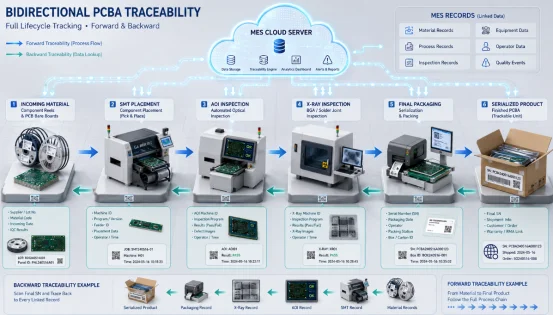
The knowledge base also describes bidirectional tracing from raw materials to finished products. That means you can start with a finished board and find its material history, or start with a suspect material lot and locate affected products. When an abnormal batch appears, this can shorten containment work considerably.
What Barcodes Cannot Prove
Barcode tracking in PCB assembly gives an item a machine-readable identity. Barcodes commonly support component tracking, work in process tracking, and inventory control. They cannot confirm that the BOM data is correct, the scanner rule is active, or the inspection plan covers the main failure risks.
The same limit applies to MES. A system record cannot replace calibrated equipment, trained operators, approved process documents, or suitable acceptance criteria.
How Should You Audit PCBA Traceability?
A practical PCBA supplier audit should test retrieval, not just ask whether an MES exists. Pick real records and follow them across the manufacturing chain.
Run a Live Retrieval Test
Choose one serial number or batch. Ask the supplier to retrieve its BOM revision, material lots, process route, inspection results, test data, rework history, and shipment record.
Then reverse the test. Select one component lot and ask which work orders, finished boards, and shipments used it. This small exercise often reveals more than a polished presentation. Watch for missing links, manual searches, and conflicting revision data.
Check Permissions and Record Retention
Ask who can change BOM information, material status, routes, test limits, and disposition results. The system should record the user, time, reason, approval, and affected production range where those controls are configured.
Do not assume a fixed retention period. Ask what the supplier keeps for your project, how records are backed up, how fast they can be retrieved, and which contractual or quality requirements set the retention period.
A Practical Traceability Path from Material to Shipment
Once the audit questions are clear, supplier capability becomes easier to judge. SCSPCBA integrates MES into its production process for material scanning error prevention, equipment data collection, production status monitoring, serial number binding, and bidirectional tracing from raw materials to finished products.
Its documented quality flow covers incoming inspection, solder paste inspection, optical inspection, X-ray, in-circuit testing, functional testing, aging tests, and outgoing checks according to project needs. SCSPCBA also supports PCB fabrication, component sourcing, SMT and DIP assembly, testing, box build, and delivery.
This connected scope can reduce record gaps between separate suppliers. Still, you should confirm the enabled data fields, inspection coverage, and retrieval rules for the actual order.
FAQ
Q1: What Records Are Needed for PCBA Traceability?
A: You should request material identity, BOM revision, process route, serial or batch links, inspection results, test data, nonconformance history, changes, and shipment records.
Q2: Can MES Trace a Failed PCBA Back to a Material Lot?
A: Yes, when the material lot was correctly scanned or recorded and linked to the production batch or product serial number.
Q3: Are Barcodes Enough for PCBA Traceability?
A: No. Barcodes identify items, but traceability also needs accurate master data, process records, inspection results, and controlled links between them.
Q4: How Long Should PCBA Records Be Retained?
A: The period depends on the product, contract, customer requirements, applicable regulations, and quality system. Confirm it for each project.
Q5: What Should You Test during a Supplier Audit?
A: Trace one finished serial number backward and one material lot forward, then check retrieval speed, record completeness, permissions, changes, and abnormal-batch containment.





Leave a Reply
Want to join the discussion?Feel free to contribute!