PCBA First Article Inspection: Pre-Production Quality Guide
A working prototype is not the same as a production-ready assembly. Before a batch starts, you need proof that the actual board matches the approved revision, BOM, placement data, polarity, soldering expectations, and test requirements. That is the point of first article inspection PCBA control.
A PCBA first article gives you a physical reference before the line repeats the build. In a sound PCBA inspection before mass production process, the board is checked against documented requirements, not appearance alone.
What Is a PCBA First Article Inspection?
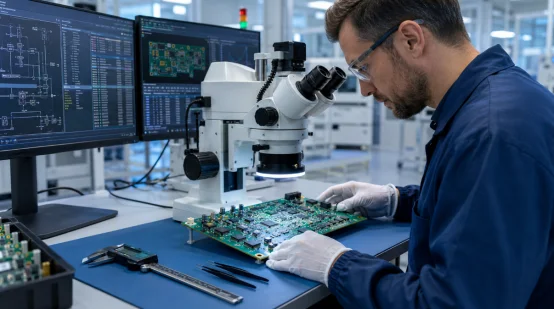
A PCBA first article inspection is a production release check used to confirm that the first assembled board meets design requirements. It comes before mass production, while in-process inspection controls the running line and outgoing inspection checks boards before shipment. These are different gates in the PCBA quality control process.
Why This Check Matters
NPI guidance gives a blunt example: a 1% yield loss on 100,000 boards means 1,000 nonconforming boards. Finding a wrong part or reversed component on the first build is much easier than sorting a full lot later. For a first article inspection PCBA review, the key question is simple: is this the assembly you want reproduced?
What Documents Should Be Checked Before First Article Inspection?
A reliable first article inspection before mass production starts with controlled production data. Engineering review should cover the PCB design files, BOM, assembly drawings, testability, and approved material alternatives.
Revision, BOM, and Placement Data
Check the current Gerber and assembly revision, BOM, part numbers, package, quantity, and pick and place data. Coordinate files define component location and orientation, so a version mismatch can put a correct part in the wrong place.
Approved substitutions need special attention. A recommended alternative is not automatically an approved substitute. The build should follow the agreed BOM, change record, or approval process. Incoming inspection should also verify component models against the BOM.
What Should Be Checked on the PCBA First Article?
Once the paperwork matches, inspect the real board. The PCBA first article turns design data into something you can compare, test, record, and approve.
Components, Orientation, and Soldering
Check component identity, package, reference location, placement offset, and missing parts. PCBA polarity inspection should cover polarized devices such as diodes, LEDs, electrolytic capacitors, ICs, and connectors.
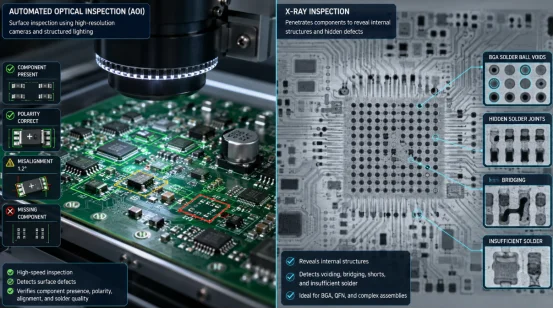
Then perform PCBA solder joint inspection for visible defects. AOI can detect missing or shifted components, reversed parts, insufficient solder, bridging, cold joints, solder balls, and tombstoning. It is useful, but it cannot see every joint.
When Is PCBA X-Ray Inspection Needed?
Hidden solder joints need a different method. PCBA X-ray inspection is relevant for BGA, CSP, and QFN, where optical inspection cannot see the solder connection underneath.
Match X-Ray Scope to Product Risk
X-ray can reveal internal solder ball condition, voiding, and bridging. That does not mean every board needs 100% X-ray. The scope should follow package type, product risk, quality plan, and customer requirements.
A supplier with PCBA testing and inspection capabilities can combine AOI and X-ray with electrical testing instead of relying on one method for every defect.
What PCBA Functional Testing Should Be Completed?
A board can look perfect and still fail electrically. PCBA functional testing should follow the agreed test requirements for the product rather than a generic checklist.
ICT and FCT Serve Different Purposes
ICT can check circuit level connectivity and component related conditions where the design and test points support it. FCT checks whether the assembled board performs its intended functions under the defined test setup. Test point accessibility and coverage should be considered during design review.
The ICT, FCT, burn-in, or environmental test scope is project specific. Fixtures, programs, acceptance limits, and report requirements should be agreed before release. A one-stop PCBA service can help when sourcing, assembly, inspection, and testing follow one controlled data set.
How Does Prototype to Mass Production Inspection Work?
A prototype mainly proves that the design can work. A prototype to mass production inspection process asks a harder question: can the same design be built repeatedly with controlled materials, process settings, inspection rules, and traceable results?
Build a Production Baseline
NPI verification can cover solder paste printing, placement accuracy, reflow profile, AOI settings, test coverage, material readiness, and traceability. Its outputs can become process standards, inspection standards, work instructions, and quality control plans.
This matters for PCBA mass production approval. The first article should not be released just because it powers on. Correct revisions, accepted materials, placement, polarity, required X-ray results, ICT or FCT results, and open deviations should all be reviewed.
What Happens If the PCBA First Article Has a Deviation?
A deviation should enter the agreed PCBA quality control process, not disappear in an informal production floor decision. Good records make later troubleshooting much faster.
Record, Correct, and Recheck
Record what failed, the affected component or function, the expected condition, the actual result, and relevant board or lot identity. Correct the issue, then repeat the affected inspection or test.
Traceability systems can connect material batches, production time, equipment, serial identity, and test data. NPI guidance also calls for written records of changes, defects, and verification activity before the next stage proceeds.
Customer approval may be required for the PCBA first article, but the exact form, approval authority, and timing depend on the project. There is no credible universal first article lead time.
What Should You Confirm Before Mass Production Release?
Before giving PCBA mass production approval, you need evidence that the approved product definition has transferred correctly to the line. This is the real purpose of first article inspection before mass production.
A Practical Release Check
Confirm the correct revision, BOM match, approved substitutions, component identity, orientation, placement, visible solder quality, hidden joint checks where required, and required ICT or FCT results. Deviations should be closed or formally accepted, and approval records should be complete.
That is what turns prototype to mass production inspection into a controlled release process rather than a simple sample check.
What Manufacturing Capabilities Support a Reliable First Article Review?
A first article process works best when assembly, inspection, testing, and traceability follow the same project data. A checklist only works if the factory can carry out the required checks.
SCSPCBA supports PCB and PCBA projects from prototype through mass production, with SMT and DIP assembly plus AOI, X-ray, ICT, FCT, and other verification options. Its quality framework includes incoming inspection, in-process control, first article confirmation, outgoing quality checks, and MES based traceability.
The SCSPCBA manufacturing platform also combines component sourcing, engineering support, PCBA assembly, testing, and box build services. For a buyer, the useful question is whether revision, material, inspection, test, and production records stay connected as the project scales.
FAQ
Q1: What is PCBA first article inspection?
A: It is a pre-production check used to confirm that the first assembled PCBA matches approved design, material, assembly, and test requirements before batch release.
Q2: What should be checked on a PCBA first article?
A: Check revision, BOM, component identity, placement, polarity, visible solder joints, hidden joints where required, and the agreed electrical or functional test results.
Q3: When is PCBA X-ray inspection required?
A: It is commonly used when important solder joints are hidden under packages such as BGA, CSP, or QFN. The exact scope depends on project risk and inspection requirements.
Q4: Is PCBA functional testing required before mass production?
A: It depends on the product and agreed quality plan. ICT, FCT, burn-in, or other tests should follow customer and project requirements rather than one universal rule.
Q5: Why is prototype to mass production inspection important?
A: It confirms that a working prototype has become a repeatable manufacturing process with controlled materials, inspection criteria, test methods, records, and release conditions.






Leave a Reply
Want to join the discussion?Feel free to contribute!