PCB vs PCBA: Key Differences & Which One Do You Need?
You send a board layout to a vendor, get a quote, and realize assembly is absent. This happens when buyers treat PCB and PCBA as the identical item. They are two phases of one project. However, the purchasing scope differs completely.
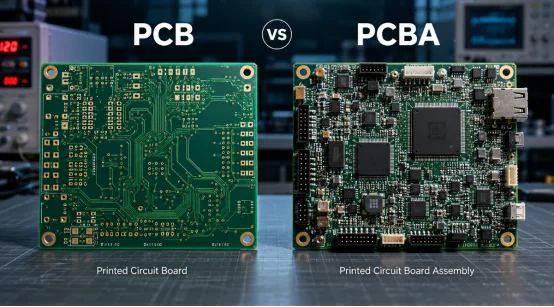
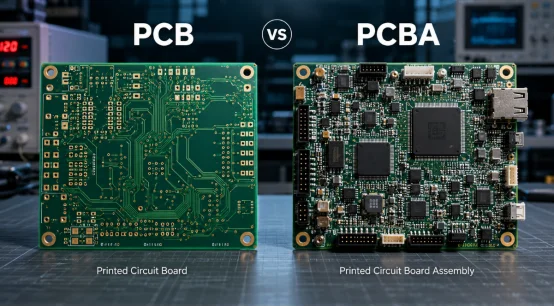
In a PCB vs PCBA comparison, a Printed Circuit Board is the raw base. It holds copper tracks, pads, holes, and insulation. Meanwhile, a Printed Circuit Board Assembly features parts soldered directly onto that base. The difference between PCB and PCBA alters your files and cost. It also shifts delivery schedules, testing, and fault responsibility. If you need one supplier for both, SCSPCBA supports jobs from prototype boards to assembled electronics and box build.
What Are PCB and PCBA?
The fastest way to settle the PCBA vs PCB question is defining what actually arrives at your door. A board might look complete with solder mask and gold pads. Yet, it remains only a bare PCB. Function starts after parts are mounted.
What Is a PCB?
A PCB provides firm structural support. It also creates electrical pathways. PCB fabrication takes several steps. These include imaging, etching, and lamination. Next comes drilling and copper plating. Solder mask application, surface finishing, and bare-board electrical testing follow. Standard builds feature multilayer, HDI, and high-frequency styles. Flexible, rigid-flex, aluminum, heavy-copper, and prototype boards remain frequent.
Production handles 1 to over 30 layers. Board thickness spans 0.4 mm to 2.4 mm. Available finishes include HASL, ENIG, OSP, immersion silver, and immersion tin. Your specific design, material choice, and copper weight set realistic limits. Impedance requirements and overall production volume matter greatly.
What Is a PCBA?
A PCBA begins with a blank board. Next, workers attach resistors, capacitors, and ICs. Connectors and sensors follow. PCB assembly utilizes SMT assembly for surface-mounted items. Meanwhile, through-hole assembly handles leaded parts. Mixed layouts demand both. BGA, CSP, or QFN soldering often apply too.
PCBA manufacturing also covers inspection and testing. The result is a circuit that can perform its intended job in industrial controls, medical devices, automotive electronics, IoT hardware, AI computing equipment, security systems, or consumer products.
How Does PCB vs PCBA Affect Cost and Lead Time?
Price is often the first concern, but the cheaper line item is not always the cheaper project. PCB and PCBA quotes cover different work, so compare scope before comparing totals.
PCB Cost and Timing
A bare board quote covers material and PCB fabrication. Layer count, dimensions, copper thickness, smallest hole, trace spacing, surface finish, controlled impedance, panel use, order quantity, and delivery speed all affect price. Gerber files and a clear fabrication drawing are usually enough to start a review.
PCBA Cost and Timing
PCB assembly cost includes the bare board, component sourcing, placement, soldering, setup, inspection, and any required test fixtures. The Bill of Materials (BOM) can drive more cost than the board itself. A hard-to-find chip may also control PCBA lead time, even when the factory has open capacity.
For a useful quote, submit manufacturer part numbers, package details, approved substitutes, quantities, and test needs. That small bit of paperwork saves a surprising amount of email later.
Should You Choose a PCB or PCBA?
Your answer depends on what your team can do after delivery. Choosing PCB or PCBA is less about product size and more about assembly resources, risk, and the stage of development.
For Early Prototypes
Choose a bare PCB when you plan to solder parts in-house or only need to check board dimensions, stack-up, impedance, or fit. Choose prototype PCB assembly when you need to power the circuit and test real behavior. A functional prototype is usually a PCBA, even if only five boards are built.
For Low and High Volumes
Low-volume PCB assembly suits engineering trials, pilot runs, and products with uneven demand. High-volume PCB assembly adds stronger reasons for automated placement, stable process controls, traceability, and repeatable testing.
Supply models matter too. With consigned PCB assembly, you provide the parts. Partial turnkey PCBA splits purchasing between you and the factory. Turnkey PCBA assembly places the board, parts, assembly, and testing under one supplier. If purchasing already takes too much of your week, turnkey work is often the cleaner route.
What Files and Tests Does a PCBA Need?
Missing production data causes more trouble than most board buyers expect. A complete package lets the engineering team check manufacturability before material reaches the line.
Production Files
Provide Gerber files, drill data, the Bill of Materials (BOM), centroid or pick-and-place data, an assembly drawing, polarity marks, and any programming file. Add test steps and acceptance limits when the circuit has a specific load, timing, communication, or safety requirement.
Inspection and Test Coverage
PCBA testing may include solder paste inspection, Automated Optical Inspection, X-ray for hidden BGA or CSP joints, In-Circuit Testing, and functional testing. PCB functional testing checks whether the assembled board performs the required task, while burn-in or environmental checks may suit higher-risk products.
Incoming checks also matter. Component model verification, packaging inspection, BOM comparison, and material sampling catch mistakes before SMT placement. MES tracking can bind material records, process data, and product serial numbers, which helps trace a suspect batch without searching through scattered spreadsheets.
When Do You Need Box Build Assembly?
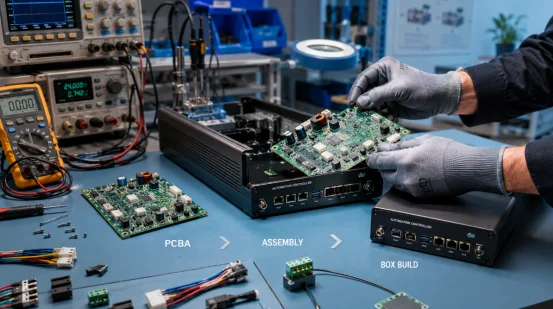
A working PCBA may still be far from a shippable product. If your deliverable needs a housing, cable harness, display, label, firmware, final test, or packaging, ask about Box Build assembly. These electronic manufacturing services move the job past board-level work and into complete product assembly.
This is also where one-stop PCB assembly can reduce handoffs. The same production plan can cover PCB manufacturing, component sourcing, PCBA testing, enclosure work, aging tests, finished-product checks, and packing.
Why Consider SCSPCBA for PCB and PCBA Production?
When you need a PCB and PCBA manufacturer, the useful question is how much of the build it can keep under one quality system. SCSPCBA combines PCB production, component purchasing, SMT and DIP lines, functional testing, and Box Build assembly. Its documented capabilities include 13 SMT lines and 6 DIP lines, placement of 01005 and 0201 components, BGA and mixed-technology work, plus SPI, AOI, X-ray, ICT, and FCT inspection.
The supplier supports prototype, low-volume, and mass-production projects across manufacturing sites in China and Vietnam. Its one-stop PCBA service includes consigned, partial turnkey, and full turnkey routes, so you can keep control of critical parts or hand over the full supply chain. Online Gerber and BOM recognition also shortens the early quoting steps. For buyers comparing PCB assembly services, that mix of board production, assembly, testing, and traceability keeps the responsibility clear.
FAQ
Q1: What Is the Difference Between PCB and PCBA?
A: A PCB is a bare circuit board. A PCBA has electronic parts installed and soldered, so it can perform the designed function.
Q2: Is a PCBA the Same as a PCB?
A: No. The PCB is the base board used to make the PCBA. The phrase bare PCB vs assembled PCB describes the same distinction in practical buying terms.
Q3: Should You Order a Bare PCB or PCBA for a Prototype?
A: Order a bare PCB for fit checks or in-house assembly. Order PCBA when you need a working circuit for electrical or functional tests.
Q4: What Is Turnkey PCBA Assembly?
A: The supplier handles PCB production, component purchasing, assembly, inspection, and agreed testing. You provide the production files and approve the parts list.
Q5: How Long Does PCB Assembly Take?
A: Timing depends on board complexity, part availability, quantity, assembly method, and test scope. Parts with long procurement times often set the schedule.






Leave a Reply
Want to join the discussion?Feel free to contribute!