
PCBA Production Workflow: What Happens from Engineering Review to Final Delivery?
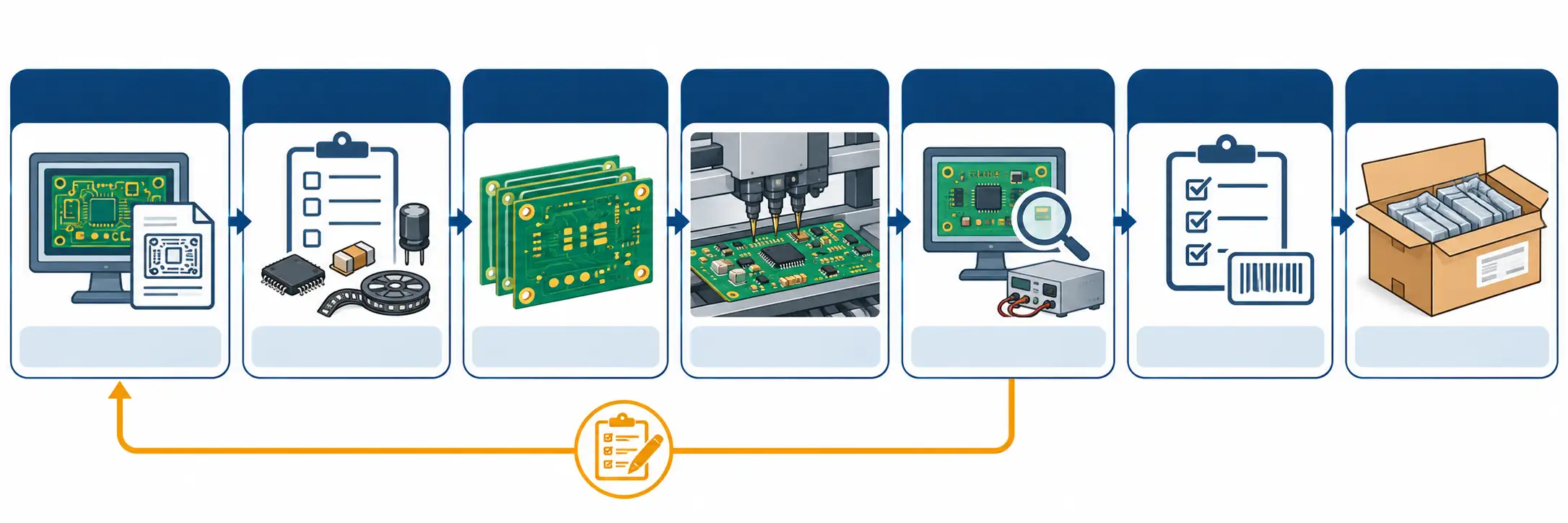
A PCBA production workflow connects engineering review, material preparation, PCB fabrication, assembly, inspection, testing and delivery. Each stage needs a defined input and an agreed handoff. For an OEM buyer, the useful question is whether the next team has the approved information and evidence needed to proceed.
That applies to AI hardware projects too. AI-assisted file recognition can support quotation preparation, while engineers still need to confirm the design, build assumptions and acceptance requirements. A quotation and a production release answer different questions.

Start with the build scope and engineering files
Before production, review the PCB design files, bill of materials and assembly drawings together. Depending on the project, the handoff may also require Gerber files, placement coordinates and test requirements. Ask the supplier to identify missing or conflicting information before treating the package as released.
A practical engineering review should leave a clear record of questions, decisions and the files approved for the build. The detailed PCBA DFM checklist expands the manufacturing and assembly checks behind this first handoff. Use it to prepare questions about the actual board rather than simply asking whether DFM has been completed.
Define the sourcing model at the same time. Turnkey, consigned and partial-turnkey arrangements divide purchasing responsibilities differently. SCSPCBA supports these models alongside prototype, low-volume and mass-production assembly. Confirm which party supplies each item and who approves a proposed change; a service category alone does not settle the order scope.
The first useful output is a build package with an identifiable revision and a list of unresolved items. For example, ask whether an open component query blocks purchasing, assembly or only a later test. Assigning that decision early gives the buyer a more useful status than a general message that engineering is underway.
Review the BOM before committing materials
BOM review can include component lifecycle, alternative-material confirmation and lead-time risk. SCSPCBA provides BOM procurement, original-component sourcing, alternative-component recommendations and BOM optimization. The project agreement should define which of these activities the supplier will perform.
Keep availability and approval separate. A proposed alternate needs a documented engineering decision before it becomes part of the approved build. Ask for the affected BOM lines, the proposed replacement and the decision owner. If approval remains open, show that status explicitly in the material-readiness review.
For an AI computing project, submit the actual component list and configuration requirements. The application label does not tell purchasing which parts may be substituted. The same discipline applies to components provided by the buyer: identify the supplied quantity, intended revision and responsibility for resolving discrepancies before scheduling assembly.
Ask for a material-readiness summary that distinguishes ordered, received, awaiting approval and unresolved items. This is a suggested reporting format, so agree it with the supplier. It gives both teams a shared way to discuss readiness without treating a purchase order as proof that all materials are available for the build.
Coordinate PCB fabrication and assembly preparation
In a turnkey arrangement, one provider may coordinate PCB manufacturing, component procurement, SMT assembly, component insertion and soldering, inspection, testing and logistics. These responsibilities should appear in the agreed project scope. The turnkey PCBA process guide provides a broader explanation of that coordination model.
Fabrication and material procurement may have separate readiness questions. Before assembly, ask which incoming checks apply to the boards and components and how discrepancies will be handled. Avoid allowing an unresolved revision question to disappear inside a general production-progress update.
Assembly can involve SMT, DIP, through-hole, BGA or mixed technology, depending on the design. Confirm the route for this board, including operations that follow the initial placement and soldering work. The useful planning document is the approved route and its inspection points, rather than a list of all processes a supplier can offer.
Establish a production baseline through first articles and pilots
First Article Inspection checks whether the first article meets design requirements before mass production. Small-volume verification can also precede a larger build. Agree the sample scope, review responsibilities and release conditions in the project plan.
NPI covers design, process, compatibility and production verification with data feedback. Its outputs can include process-parameter standards, inspection standards, work instructions and quality-control plans. Together, these form a baseline for subsequent production.
Use the first-article or pilot review to decide what changes before the larger run. A useful issue list identifies the observation, disposition, owner and required confirmation. Ask whether the approved action changes a drawing, BOM, work instruction or test requirement, and make that document part of the release review.
For mass-production readiness, the document set may include the released BOM, drawings, SOPs, inspection specifications, control plan and equipment parameters. Drawing freezes and engineering-change records help define the current baseline. Select the documents appropriate to the product and quality agreement rather than demanding identical paperwork for every project.
Do not leave pilot findings as an email attachment with no release decision. Ask which findings are closed, which are accepted under an agreed condition, and which remain open. The customer and supplier should know who can approve each disposition before the production quantity is released.
Place inspection and tests where they answer a defined question
Inspection and testing have different scopes. Select them around the design and agreed requirements, and identify what evidence each step will produce.
| Method | Main question addressed | Boundary to confirm |
| SPI | Is solder-paste printing acceptable? | Agreed printing checks and acceptance criteria |
| AOI | What visible surface conditions need attention? | Hidden joints need another inspection approach |
| X-ray | What can imaging reveal about concealed joints? | Imaging scope and interpretation requirements |
| ICT | Do tested interconnections and component parameters meet requirements? | Accessible points and selected test items |
| FCT | Does the board perform its intended functions under the test conditions? | Functions, configuration and pass criteria |
BGA and QFN solder joints lie beneath the component and cannot be directly observed by AOI. X-ray provides imaging of concealed joints. ICT addresses board-level interconnections and component parameters; FCT verifies designed functions under simulated use conditions. These distinctions should shape the inspection and test plan.
Passing ICT or FCT confirms the corresponding test items. Additional aging, fatigue or environmental testing depends on the product mission profile and reliability specifications. Specify test scope, execution location and required reports in the project solution before final acceptance.
Release the shipment with the agreed records
Manufacturing traceability may include serial numbers, material records, process parameters, firmware or configuration versions, inspection results and test data. Required fields and retention periods depend on the product and applicable quality requirements. Confirm the actual record set for the order.
Before shipment, review acceptance status alongside packaging, shipping responsibility and the reports due with delivery. If partial delivery is proposed, ask how the delivered quantity relates to the approved lot and its records. These are matters to agree in the handoff, rather than assumptions to resolve after receipt.
For repeat orders, identify the approved baseline that the next purchase order will reference. Ask whether a new component decision, drawing revision or test change requires another engineering review. Keep that discussion separate from the current shipment’s acceptance decision. A buyer should be able to identify what was delivered and what information will govern the next build.
A short handoff review can cover the released revision, accepted quantity, outstanding exceptions, required reports and shipment responsibility. Have the relevant owners confirm their items. This is a proposed buyer checklist, not a claim that every supplier uses an identical final-release procedure.
Keep commercial scope aligned with the engineering scope. The PCB assembly quote comparison guide helps buyers compare what has been included in materials, testing and delivery. Revisit those assumptions when an engineering change alters the agreed work.
Where AI assistance fits into the workflow
SCSPCBA’s platform functions include AI Gerber recognition, BOM intelligent matching, automatic price calculation and online PCB/PCBA quotation. AI computing is also one of its application areas. These functions provide a relevant starting point for discussing an AI hardware build.
Use the quotation stage to confirm the interpreted files and assumptions with the engineering team. Keep the approved build revision, component decisions and test scope identifiable throughout the project. File recognition should not be treated as engineering approval or a prediction of manufacturing yield.
To discuss a build with SCSPCBA, send the current manufacturing files, structured BOM, target quantity and test requirements. Request a preliminary project review covering the proposed sourcing model, open engineering questions and delivery scope.
FAQ
Does every PCBA order follow the same sequence?
No. The design, sourcing model and agreed scope determine the route. Confirm the actual operations, review points and handoffs for the order.
Is a first article the same as a pilot build?
FAI checks the first article against design requirements. A pilot can support broader production verification. Define the purpose and release conditions of each planned activity.
Does a functional-test pass prove long-term reliability?
It confirms the functions covered under the test conditions. Further reliability testing depends on the product mission profile and specifications.