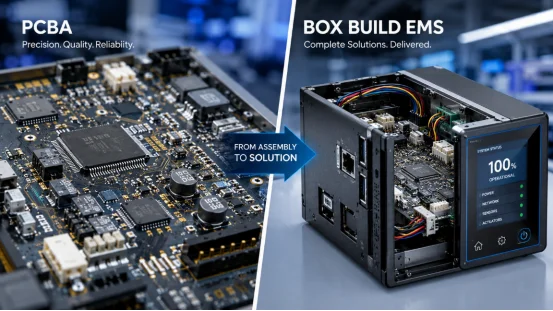
Difference Between EMS and PCBA Manufacturing
Your quote says PCBA, but your product plan also needs parts purchasing, firmware loading, enclosure work, and final shipment. Is that still PCBA manufacturing, or has it become EMS? The short answer is simple. A printed circuit board assembly is the populated board, while electronic manufacturing services can cover much more of the product journey. PCBA is often one service inside EMS.
That difference affects who owns component shortages, test fixtures, revision control, and the awkward gap between a working board and a finished device. When comparing EMS vs PCBA manufacturing, define the result you need first. The label on the quote comes second.
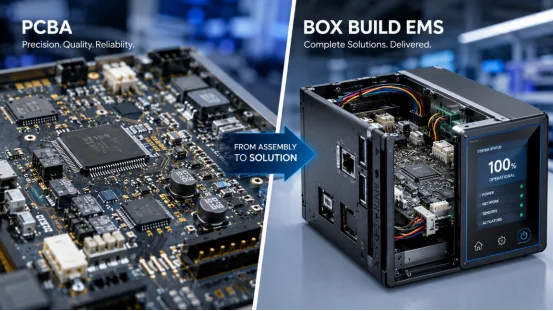
What Is PCBA Manufacturing?
PCBA manufacturing turns a bare PCB and a set of electronic components into an assembled circuit board. The work usually starts with Gerber data, a bill of materials, pick-and-place data, and assembly drawings. It ends with populated boards that meet an agreed inspection and test plan.
Assembly Processes and Board-Level Checks
Typical PCB assembly services include solder paste printing, surface-mount placement, reflow soldering, through-hole insertion, and wave or selective soldering. Mixed-technology boards may use several of these steps. Fine-pitch devices, BGA packages, QFN packages, and tiny passives need tighter process control than a simple single-sided board.
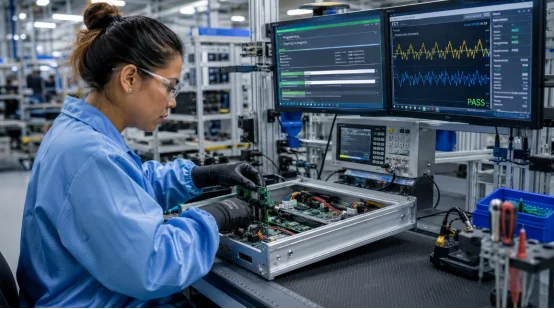
Inspection normally follows the process risk. Solder paste inspection checks paste volume before placement. Automated optical inspection catches missing parts, polarity errors, and visible solder defects. X-ray inspection looks beneath packages whose joints cannot be seen. In-circuit testing checks connections and component values, while functional testing powers the assembly and checks its intended behavior. A board can look perfect and still fail when it boots. That happens more often than purchasing teams would like.
A PCBA manufacturer may also buy components, program devices, apply conformal coating, or run burn-in tests. Even so, the contracted output remains a board-level assembly unless the scope says otherwise.
What Are Electronic Manufacturing Services?
Electronic manufacturing services cover a wider operating role. An EMS provider may support design review, PCB fabrication, component sourcing, assembly, testing, cable and harness work, enclosure integration, packaging, repairs, and logistics. The exact scope is contractual. Three letters on a website do not settle it.
Product-Level Responsibility
The biggest change is ownership. With a board-only order, you may manage the enclosure supplier, cables, firmware, final test, and shipping separately. Under a broader EMS program, one supplier can coordinate those stages and maintain a shared revision trail.
That wider role often includes supply chain management. The supplier tracks lead times, approved alternates, minimum purchase quantities, moisture-sensitive parts, lifecycle status, and material traceability. If a microcontroller becomes unavailable, the job is not merely to find a similar part. Engineering must check the footprint, electrical behavior, firmware impact, compliance status, and test coverage before substitution.
Box build assembly is another common boundary marker. It can include mounting the PCBA in its housing, fitting displays and cables, loading software, applying labels, running final functional testing, and packing the finished unit. At that point, you are buying a manufacturing workflow, not just populated boards.
How Do EMS and PCBA Manufacturing Differ?
PCBA and EMS overlap, but they answer different purchase questions. PCBA asks who will build and verify the circuit board. EMS asks who will manage enough of the manufacturing chain to deliver the agreed product or subassembly.
| Area | PCBA Manufacturing | EMS Scope |
|---|---|---|
| Main output | Populated and tested circuit board | Board, subassembly, or finished product |
| Usual inputs | Gerber, BOM, placement file, drawings, test data | PCBA data plus mechanical files, firmware, packaging, forecasts, and logistics rules |
| Purchasing role | Bare boards and parts for the assembly | Broader component sourcing and supply chain management |
| Test level | SPI, AOI, X-ray, ICT, and board functional testing as specified | Board tests plus system test, final inspection, and product acceptance |
| Later operations | Sometimes programming or coating | Often box build assembly, labeling, packing, repair, and shipment |
| Best fit | You control the rest of the product flow | You want fewer handoffs and wider accountability |
The border can move. A capable PCBA manufacturer may offer many EMS activities, and an EMS provider may accept a board-only job. Read the statement of work, quotation exclusions, and acceptance criteria instead of relying on the supplier category.
Which Service Fits Your Project?
Choose based on the work your team can control well. Keeping some tasks in-house is sensible when your engineers own validated test fixtures, your purchasing team has secure component allocations, or final integration uses protected processes.
When PCBA Is Enough
PCBA manufacturing is usually enough when you need assembled boards and already have a reliable route for final integration. It also suits engineering prototypes where the immediate goal is electrical validation. You keep more control, and the quotation is easier to separate into board, parts, setup, and test costs.
The catch is coordination. A mechanical change can affect connector access. A firmware revision can change the test procedure. If different vendors work from different revisions, a small document error may stop the whole build.
When EMS Makes More Sense
EMS is useful when you need one owner across purchasing, production, system test, and delivery. It can also help during the move from prototype to mass production, when informal engineering habits must become repeatable instructions, traceable material records, and controlled change notices.
Do not assume broader service always means lower cost. It usually adds engineering, program management, fixtures, packaging, and inventory work. The value comes from fewer handoffs, clearer accountability, and less duplicated inspection. For a complex product, those avoided problems can matter more than the lowest placement price.
What Should You Confirm Before Requesting a Quote?
A useful quote should show what the supplier owns and what remains with you. Ask for clear pricing and acceptance terms. Turnkey PCBA normally puts PCB fabrication, parts purchasing, assembly, and agreed testing with one supplier, while consigned work uses materials you provide. Partial turnkey arrangements split that responsibility.
Confirm the following points in writing.
- Who approves component substitutions and excess material purchases?
- Are programming, test fixtures, X-ray inspection, rework, and failure analysis included?
- Does quality control follow the required IPC class and industry rules for your product?
- Will serial numbers link each board to material lots, process records, and test results?
- Where does responsibility end, tested PCBA, integrated subassembly, or packed product?
Send matching revisions of the Gerber files, BOM, placement data, assembly drawings, firmware, and test limits. Add expected order quantity and annual demand. A fast quote built on incomplete files is often just an early estimate wearing a tidy price tag.
How Can One Partner Close the Gap between PCBA and EMS?
Once your project needs sourcing, board assembly, programming, testing, and product integration, switching suppliers at every step creates revision and accountability gaps. The practical answer is a partner that can keep board-level details visible while managing the wider build.
SCSPCBA links PCB fabrication, BOM sourcing, SMT, and through-hole assembly into a single workflow. It adds inspection, functional testing, programming, and box build. The facility supports fine-pitch packages, X-ray inspection, and MES-linked traceability. Online Gerber and BOM review become vital as projects scale past basic assembly.
Start with a prototype or small batch. Next, validate the process and test records. Then, expand your scope. You avoid rebuilding the supplier chain. This makes the PCBA-to-EMS transition simpler to manage. It helps heavily if engineering changes happen often.
FAQ
Q1: Is PCBA the same as EMS?
A: Not exactly. PCBA just means building a populated circuit board. EMS goes further. It adds parts sourcing, product integration, and testing. It also handles packaging and logistics.
Q2: Can a PCBA manufacturer offer EMS?
A: Absolutely. Several board assemblers now include procurement and programming. They also tackle box build tasks. Just verify their written scope first. Actual capabilities differ across suppliers.
Q3: Is Turnkey PCBA an EMS service?
A: It forms a portion of EMS. Turnkey PCBA handles the board, components, and assembly. It includes specific tests. However, it normally stops before enclosure assembly or final shipment.
Q4: Which option is better for a prototype?
A: PCBA usually suffices for initial electrical validation. But pick EMS if your prototype needs an enclosure, cables, or firmware. It also helps if you require final product-level tests.
Q5: What Is the Biggest Risk When Moving from PCBA to EMS?
A: Unclear responsibility. Define revision control, substitution approval, fixture ownership, test limits, traceability, excess inventory, and the exact delivery state before production starts.




-80x80.png)

Leave a Reply
Want to join the discussion?Feel free to contribute!