How Modern EMS Providers Improve PCBA Manufacturing Through Automation and Quality Control
Automation helps PCBA manufacturing when the assembly program, inspection results, materials, and production records stay connected. An EMS team can then see what was built and what needs attention as samples move into volume production.
For an OEM developing an AI device, start with the route your board will take through the factory. Where do the manufacturing instructions come from? What happens to a failed board? Follow a finding back to the person who can act on it. That is where automation becomes useful to the project.
Start with a controlled SMT and DIP workflow
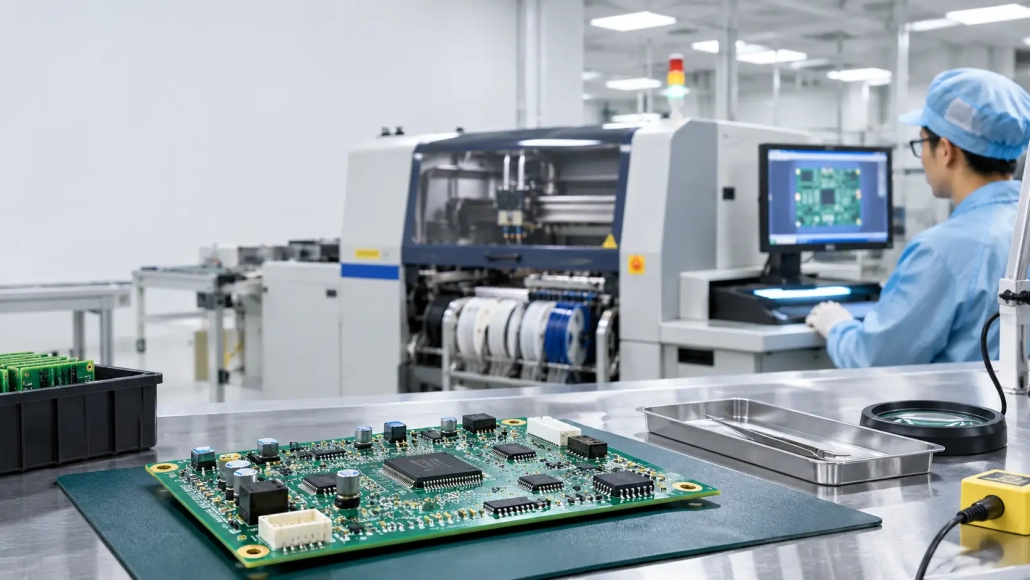
In SMT and DIP assembly, components reach the board in different ways. Automated SMT equipment places them on its surface; through-hole components have leads inserted through holes and soldered in place. SCSPCBA’s assembly scope covers both, including BGA and mixed-technology work, from prototypes and small runs through mass production.
The BOM and coordinate files supply the information for the placement program. The initial assembly then goes through first-article confirmation. Trial builds establish a workable process window by checking paste thickness and volume, placement displacement and angle, reflow settings, and AOI calibration. The resulting settings go into work instructions.
A mixed assembly needs attention after insertion, too. Take a connector installed after surface mounting. Put its inspection point in the route and identify the test that exercises its connections. Make the responsibility for those later checks clear.
At changeover, review the released board revision and assembly program with the stencil, materials, and inspection instructions. Have the lead record the first-article decision before continuing. Resolve any disagreement between a reel, file, or instruction at that point, and carry the decision into the instructions for the run.
Give each inspection method a specific job
Start the inspection plan with the board and the defects at issue. SCSPCBA has SPI, AOI, X-ray, ICT, and functional testing within its inspection scope. Which checks to apply, and their coverage, are decisions for the product under review.
SPI checks the printed solder paste
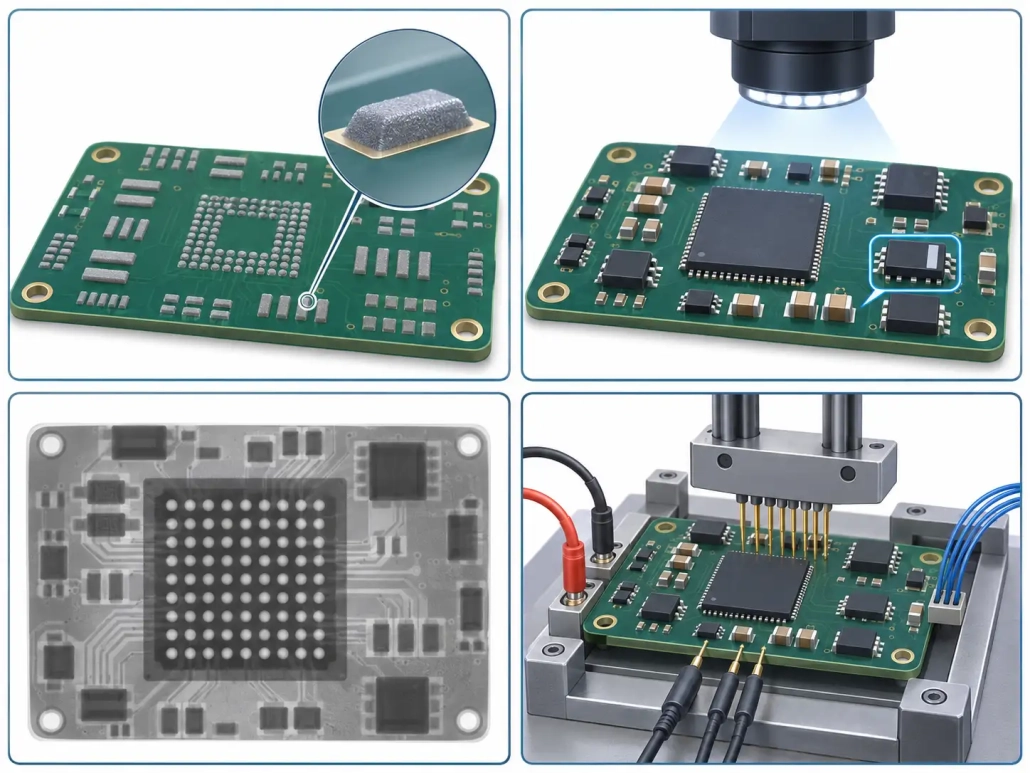
Before there are components over the deposits, SPI examines the printed solder paste. The print is assessed through thickness, area, shape, and offset. It can identify a deposit that is too small, too large, displaced, or smeared. The data is available to inform the placement and soldering operations that come next.
AOI examines visible assembly features
AOI works from optical images and image comparison. A missing part or reversed component is visible, as are placement errors, tombstoning, and visible solder bridges. The inspection has no direct view of joints underneath a package or of internal defects. Its extent is set by the product quality plan.
X-ray examines hidden solder connections
The connections underneath a BGA or QFN call for a different view. X-ray can show hidden solder-joint structure and reveal voids, bridges, or abnormal solder volume. Resolving an open, wetting problem, or interface crack may take angled imaging, CT, or another method alongside that view.
ICT examines interconnections and component parameters; FCT exercises the functions specified for the finished board. Each result applies to the items tested. Whether the product also needs aging or environmental tests is determined by its intended use and reliability requirements.
Take a failure that matters to the design into the testing and inspection discussion. Ask what check will catch it, where the acceptance limit comes from, and what happens to a failed board. With an AI design, propose the firmware, interfaces, and workload conditions you want exercised, then get the test plan agreed.
Turn an inspection finding into a process decision
Suppose a paste print raises a concern during a hypothetical pilot build. Take the affected board and its printing result into the review. Examine the deposit at issue, check the inspection setup, and compare the finding with the accepted limit. Have engineering give the boards a hold or release disposition while the printing condition is investigated. Keep that decision with the original result.
After a proposed correction, define what will demonstrate that the change is acceptable. That might include another paste measurement and the relevant downstream solder-joint checks. Record the new setting, the reviewed results, and the authorization to resume. This example describes a decision sequence; the actual measurements and limits must come from the product’s process plan.
AOI calibration also considers false calls alongside defect detection. That work belongs in process verification. During setup review, give an uncertain image a clear route to a disposition. The operator holding the board needs to know who can resolve it before it moves on.
Use manufacturing data to investigate the process
A board’s history can be recorded through its materials, process parameters, configuration or firmware version, inspections, and test results. The record may also identify material lots, manufacturing time, equipment, and operators. The product and applicable quality requirements determine how far that history goes and how long it is kept.
At SCSPCBA, MES brings material scanning together with equipment data, production status, and serial-number binding. This connects finished products back to materials and materials forward to finished products. In-process sampling and outgoing appearance and functional checks are part of its quality process. Repaired boards return for secondary inspection.
Use a repeating solder defect as a starting question for the records. Do the boards share a material lot or production condition? Read those findings with the inspection results. Statistical process control helps identify abnormal trends, after which engineering needs to decide what to hold, investigate, and verify.
Keep BOM control connected to the production line
BOM review also takes in alternatives and component lifecycle, together with lead-time risk. Where a part has a long lead time, material preparation and inventory monitoring are needed in planning the build.
BOM and supply chain management at SCSPCBA covers procurement, original component sourcing, alternative recommendations, and BOM optimization. Before materials enter production, incoming checks compare them with the BOM and examine the model, appearance, and packaging integrity. Key materials are sampled as part of that inspection.
Agree how alternatives reach engineering approval. Ask the project team to identify the affected BOM position and record the accepted replacement against the intended build revision. For a proposed AI processor or memory change, specify which functions and operating conditions need another review. Purchasing availability is one input to that decision.
Carry the sample findings into volume production
NPI takes the design through process, compatibility, and production verification, using feedback from the results. The handover includes the process parameters and inspection standards, with work instructions and quality-control plans. That set becomes the mass-production baseline. A departure outside its specified range goes through the quality process.
Production verification works through the complete route, considering cycle time and staffing alongside material movement. First-article confirmation, inspection points, response to abnormalities, and capture of traceability data are examined as part of it. The production documents and a trial report with a closed rectification list belong in the handover.
At the next build, compare the released instructions with what was established during the trials. Check that open findings have an owner and a recorded disposition. Discuss any new material or process condition before treating the earlier result as applicable. This keeps the sample-to-volume discussion focused on changes that need a decision.
Think about the following run during the sample handover. Identify the approved instructions, where findings will be recorded, and how a deviation reaches engineering. Put accepted sample-build corrections in the instructions used next time, so another shift can follow the same reference.
Use AI quotation within the engineering workflow
SCSPCBA’s AI quotation workflow includes PCB and PCBA online quotation, intelligent BOM matching, AI Gerber recognition, automatic price calculation, online order management, and production progress tracking. SCSPCBA also offers design review, DFM analysis, manufacturing optimization, and prototype verification, and serves AI computing applications.
Reconcile the quoted configuration with the files going into production. Work through component choices, inspection, testing, and the documents to be delivered with engineering. As quantities or files change, take the updated build and its acceptance requirements back through approval.
Send SCSPCBA the Gerber files, BOM, assembly information, quantities, and testing needs for a one-stop PCBA build review. Use that discussion to agree the manufacturing route and resolve material questions, with the remaining verification work identified before volume production.
FAQ
Does an automated SMT line eliminate inspection?
Inspection accompanies automated assembly. Paste, visible features, hidden joints, and electrical or functional performance are examined through different methods. Select the combination for the product and the checks it requires.
When is X-ray useful in PCBA production?
X-ray is useful when solder connections are hidden beneath packages such as BGA and QFN. Choose the extent of inspection for the product quality plan, and agree which features will be examined and how they will be accepted.
What should follow a successful sample build?
Complete the production verification and document the manufacturing baseline. Carry the approved process settings, inspection instructions, and resolved trial findings into the volume build