Turnkey vs. Consigned PCBA: Which Sourcing Model Fits Your Build?
A PCBA supplier can quote the same board under three very different material arrangements. In a full-turnkey build, the manufacturer sources the components. In a consigned build, the customer supplies them. Partial-turnkey sits between those two models. The assembly process may look similar on the factory floor, but purchasing responsibility, inventory exposure, and shortage handling change with the sourcing model.
The right choice depends on the parts you control, the time your team can spend on procurement, and the records your project needs. Price matters. Responsibility matters just as much.
What full-turnkey PCBA covers
Under a full-turnkey arrangement, one manufacturer manages the agreed PCB fabrication, component sourcing, assembly, inspection, and testing scope. The customer provides the approved manufacturing files, BOM, quantity, and project requirements. The supplier then purchases the listed components and coordinates them with production.
This model gives the buyer one commercial and technical interface for the build. It can reduce the work of placing component orders, tracking inbound shipments, checking kit completeness, and resolving shortages across several vendors. The quoted total also carries more of the material cost, so it should state which manufacturer part numbers and purchasing assumptions were used.
Full turnkey fits teams that want a single point of coordination or do not maintain an established electronics component supply chain. It also suits projects where PCB fabrication, component procurement, SMT or DIP assembly, and testing need to move under one controlled schedule. The buyer still approves the BOM, substitutions, test scope, and design changes.
How consigned PCBA changes the responsibility
In a consigned build, the customer supplies the components covered by the consignment agreement. The manufacturer receives the kit, checks it against the supplied records, and performs the agreed assembly and test work. PCB supply may be included or handled separately, depending on the quotation.
Consignment keeps purchasing control with the customer. That can make sense when a company already owns inventory, has negotiated supply agreements, or must provide a controlled component. It can also help when a long-lead device has already been secured for the project.
The customer carries more of the material risk. Parts must arrive in the correct package, quantity, and condition. A short kit can stop production. Incorrect labels, mixed date codes, damaged moisture-sensitive packaging, or missing overage may require clarification or replenishment. The quote should explain incoming verification, shortage reporting, unused material, and return handling.
Partial-turnkey PCBA handles the middle ground
Partial-turnkey assembly divides the BOM. The customer supplies selected items, while the manufacturer sources the remaining components. A common reason is control of a programmed device, allocated IC, custom connector, or existing stock. The manufacturer can then procure standard passives and other agreed parts.
This model is flexible, but the handoff must be explicit. Mark every BOM line as customer supplied or supplier sourced. State the quantities, packing information, expected arrival date, and approval rules for alternative parts. Both sides should know who closes a shortage before the production slot begins.
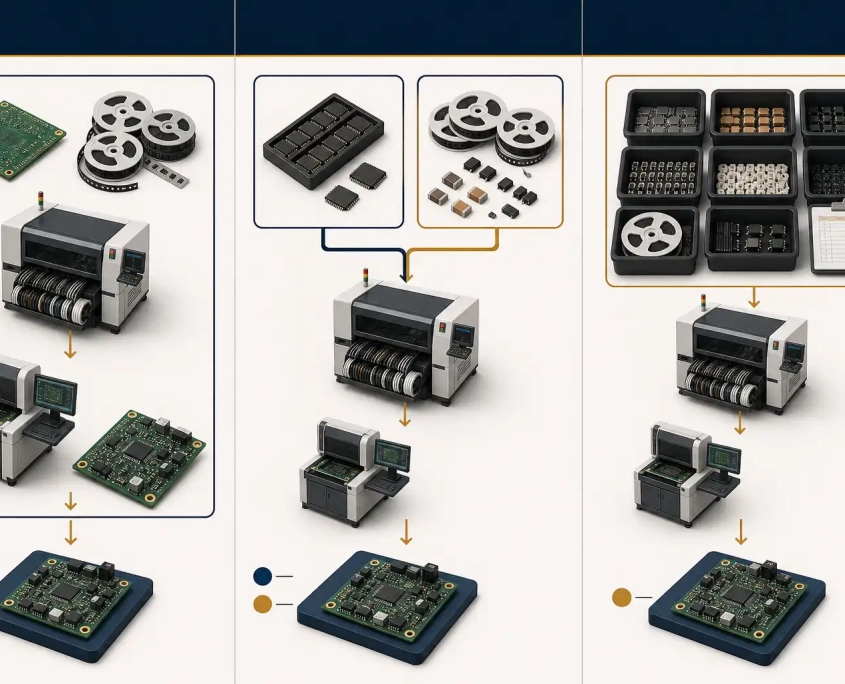
Responsibility comparison
| Item | Full turnkey | Partial turnkey | Consigned |
| Component purchasing | Supplier | Shared by BOM line | Customer |
| Customer inventory use | Usually limited | Selected parts | Primary material source |
| Kit completeness | Supplier manages sourced parts | Shared responsibility | Customer responsibility |
| Alternative proposals | Supplier may propose; customer approves | Depends on assigned BOM lines | Usually customer controlled |
| Material logistics | Supplier managed within scope | Shared | Customer sends kit to factory |
| Best fit | Single coordination point | Control of selected parts | Established customer supply chain |
Compare total project cost, not one unit price
A consigned assembly quote can look lower because the customer has already paid for the components. That does not make it cheaper by itself. Add the cost of component purchasing, inbound freight, customs handling, inventory, shortages, and internal labor before comparing it with a turnkey quote.
The same rule applies to partial turnkey. Separate customer-owned material from supplier-sourced material, then compare assembly, tooling, testing, packaging, and logistics on the same basis. Keep one-time charges visible. A stencil or test fixture may serve later orders, but a design revision can require changes.
Set the material rules before placing the order
A sourcing model works only when the BOM and material rules support it. For customer-supplied parts, provide a packing list with the manufacturer part number, quantity, and package identification. Mark do-not-fit positions and approved substitutions. Tell the factory whether unused parts should be returned, stored, or handled under another agreed instruction.
For supplier-sourced parts, require approval before an alternative replaces the specified item. The engineering team should review electrical function, package, footprint, ratings, lifecycle, and any project-specific compliance need. Purchasing availability alone does not approve a substitute.
Use the same revision across the Gerber data, BOM, coordinate file, assembly drawing, and test instructions. A clean release package reduces the chance that the sourcing model becomes tangled with a documentation error.
Questions to settle with the supplier
- Which BOM lines will each party purchase?
- How will the supplier report shortages, damaged packaging, or quantity differences?
- Who approves alternative components, and what evidence accompanies the proposal?
- What component overage is required for setup or process loss?
- How will unused and customer-owned materials be identified, stored, and returned?
- Does the quotation include PCB fabrication, assembly, inspection, testing, packaging, and freight?
- How will a BOM or PCB revision affect purchased material and existing inventory?
Choose the model that matches your control points
Choose full turnkey when your team wants the manufacturer to coordinate PCB fabrication, component sourcing, assembly, and the agreed test scope. Choose consigned assembly when your organization needs direct control of the parts and can deliver a complete, production-ready kit. Use partial turnkey when selected components must stay under customer control while the supplier handles the rest.
SCSPCBA supports turnkey, partial-turnkey, and consigned PCBA projects. Send the current Gerber data, BOM, assembly quantity, sourcing split, and test requirements with the quote request. A clear responsibility map gives both teams a better starting point than a sourcing label alone.






Leave a Reply
Want to join the discussion?Feel free to contribute!