An Engineering Perspective: How AI Hardware Challenges PCBA – and How We Respond

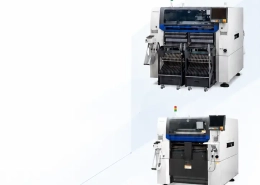
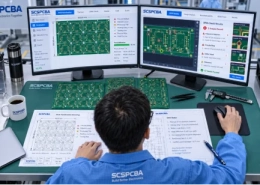
AI-enhanced PCBA assembly – precision placement with live process monitoring.
1. The Bottom Line – AI Doesn’t Just Change the Chip; It Reshapes the Entire Design and Manufacturing Logic of PCBA
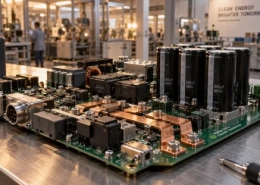
For those of us in process engineering, the phrase “just add a few more layers and push the current a bit higher” always makes us wince. But that is exactly what AI servers and accelerator cards demand. GPU/NPU power consumption now routinely exceeds 300–400 W, with peak core currents approaching 1000 A, while signal interfaces are already running at PCIe 5.0 (32 GT/s) and moving towards PCIe 6.0 (64 GT/s). This is not a matter of simply stacking more materials; it forces an upgrade of our entire manufacturing baseline – from material selection and stack‑up design, through component placement and soldering, all the way to inspection and test.
Today’s mainstream AI compute boards typically have 22 to 26 layers, with high‑end designs exceeding 30 layers, and they must use HDI with any‑layer via stacking – often 6‑ to 8‑step HDI, whereas conventional communication boards rarely go beyond 2‑step. As layer count increases, the process windows for lamination alignment, dimensional stability (shrinkage/expansion), and aspect ratio control become extremely tight. Our internal rule of thumb is that layer‑to‑layer shrinkage deviation must be kept within ±15 μm; otherwise, buried and blind vias will be misaligned, and the electrical test will fail outright.
2. Material Selection: Low Loss Is Not a Slogan – It Is Forced by Insertion Loss Budget
In the past, M4‑grade copper‑clad laminates (CCL) were sufficient for servers. Today, for AI backplanes and switch boards, the dielectric constant (Dk) and dissipation factor (Df) must meet M7/M8 levels, with Df typically <0.005 at 10 GHz. However, these materials have drawbacks: higher Tg, poorer flowability during lamination (requiring lamination temperatures 15–20 °C higher than standard FR‑4), and significant moisture absorption. We are forced to add a vacuum baking step before lamination and strictly control storage humidity below 30% RH; otherwise, we see white spots or delamination after pressing, and X‑ray inspection reveals excessive voids.
Moreover, high‑speed signals are extremely sensitive to via stub length. Our current design rule mandates back‑drilling depth control within ±50 μm, leaving a residual stub no longer than 8 mils. This puts enormous pressure on drilling and back‑drilling operations – drill bits wear out quickly, and we must change them every 300 holes. For every batch, we use TDR (Time‑Domain Reflectometry) to verify impedance consistency, ensuring differential impedance stays within 100 Ω ±5%.
3. Placement and Soldering: Three Headaches – Large BGAs, Miniature Passives, and Board Warpage
Large BGAs – AI chips often come in packages exceeding 50×50 mm with more than 10 000 solder balls at pitches of 0.8 mm or even 0.5 mm. Placement machines must achieve a Cpk ≥1.67. We use high‑end platforms (e.g., Fuji NXT or Siemens X‑series) with placement force controlled to 2–3 N. At the same time, we rely on 3D solder paste inspection (SPI) to monitor print thickness – target 120 μm with an upper/lower limit of ±10%. If paste thickness deviation exceeds 15%, the void rate (measured by X‑ray) of BGA joints will jump from ~8% to over 25%, leading to early cracking during thermal cycling tests.
Miniature passives – 01005 (0.4×0.2 mm) components are now widely used in AI smartphones and edge modules. Stencil design can no longer rely on empirical rules alone. We use stepped stencils (0.08 mm local thickness) with rounded apertures to improve paste release. Conventional AOI algorithms produce a high false‑call rate for these tiny parts; after switching to a deep‑learning‑based inspection model, our false‑call rate dropped from 12% to 2.3% – more on that later.
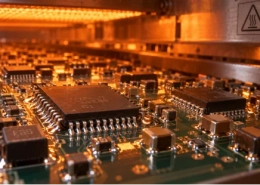
Board warpage is perhaps the most troublesome. AI boards are large (typically >400×500 mm) and populated with heavy components on both sides. During reflow, uneven heating can cause warpage exceeding 0.75% (industry standard is usually 0.5%). We address this by using a segmented reflow profile with a reduced ramp‑up rate (<1.5 °C/s) in the preheat zone, adding susceptor supports inside the oven, and designing stiffeners along the board edges. In practice, we have reduced warpage from 0.8 mm to under 0.3 mm.
4. Thermal Management and Power Integrity: Heat and Electricity Are Tightly Coupled
Power delivery to AI chips is a major engineering challenge. With a GPU core voltage of 0.8 V and peak currents of up to 800 A, the PCB must allocate multiple power layers (typically 2–3 layers with 2‑oz copper) and place the voltage regulator module (VRM) as close to the chip as possible, keeping trace resistance below 0.5 mΩ. In the design phase, we now co‑simulate thermal and electrical performance iteratively, ensuring that the maximum temperature rise does not exceed 40 °C.
For heat dissipation, besides heatsinks and fans, we are embedding copper coins or using buried thermal vias to conduct heat from the back of the chip directly to the underside heatsink. However, embedded copper coins create their own headaches during lamination and drilling – micro‑cracks tend to form at the copper‑resin interface. We have improved yield from 73% to 89% by adopting a pre‑embedding + secondary lamination process.
5. Inspection and Test: AI Helps Us with Quality Control
Earlier I mentioned deep‑learning‑based AOI, which we introduced last year. Traditional AOI relies on template matching and struggles with variations in solder‑joint morphology – especially on AI boards with numerous component types and varying pad colours, leading to excessive false alarms. We have deployed a ResNet‑based defect‑classification model, trained on our own library of ~200 000 NG (no‑good) images accumulated over the past two years. It can now identify 12 defect classes (including insufficient solder, excess solder, bridging, head‑in‑pillow, tombstoning, shift, lifted leads, etc.) with an inference time <50 ms and a miss rate below 0.3%.
For BGA and LGA joints, we mandate 100% X‑ray inspection, with AI‑assisted automatic void‑rate calculation replacing manual visual judgement. Boards with void rates exceeding the 25% threshold are automatically rejected.
In ICT (in‑circuit test) and FCT (functional test), we have introduced an AI‑based anomaly‑detection system that monitors time‑series data – test currents, voltages, and frequency‑response curves. It is far more sensitive than fixed threshold limits. For example, a power rail might pass at room temperature but show abnormal ripple at 85 °C; traditional test methods would miss this, but our AI system, comparing waveforms across the full temperature range, can flag it immediately.
6. Closed‑Loop Process Data and Smart Production Scheduling
Our factory MES system collects real‑time data from all critical equipment (placement machines, reflow ovens, AOI, ICT). Each board carries a unique QR code that links to its process parameters and inspection results. Using this data, we have trained a yield‑prediction model that can forecast potential issues before the SMT line even starts – e.g., if historical data shows that a particular component is prone to defects, the system automatically adjusts printing parameters. During production, if SPI data shows a drift trend (e.g., continuous decline in paste thickness), the system alerts the operator and recommends a stencil wipe, shifting from post‑event inspection to proactive prevention.
For production scheduling, AI server boards are typically low‑volume, high‑mix, and high‑value (tens of thousands of dollars per board). We use reinforcement‑learning algorithms to schedule production, taking into account placement‑machine nozzle configurations, reflow‑oven loading, and test‑equipment availability. As a result, our overall equipment effectiveness (OEE) has improved from 72% to 85%.
7. A Practical Note – Conformal Coating and Protection
AI servers operate in high‑temperature, high‑humidity environments. Traditional spray‑coating of conformal film presents headaches in masking and film‑thickness control. We recently switched to a selective self‑assembled nano‑coating that uses molecular self‑orientation to cover only the areas requiring protection, eliminating the masking step. The coating thickness uniformity is now within ±0.5 μm, and our rework rate has dropped from 3.2% to 0.15% – a change that has had the most direct impact on operational cost.
To sum up: AI does not bring a single‑point upgrade to PCBA; it forces a full‑chain, hard‑core evolution – from materials, stack‑up, placement, soldering, and inspection to data management and closed‑loop control. As engineers, we must not focus solely on equipment precision; we also need to emphasise process data feedback and AI‑assisted decision‑making. That is the fundamental difference between merely “getting boards built” and “getting them built right – consistently.”
 SCSPCBA October 2026 Update: SMT Equipment Upgrades, Flying Probe Testing and Online OrderingOctober 16, 2026 - 11:50 am
- SCSPCBA 2026 Holiday Production ScheduleSeptember 20, 2026 - 12:00 am
- How to Choose a PCBA Manufacturer for OEM & ODM ProjectsSeptember 18, 2026 - 12:00 am
- What Is Turnkey PCBA Manufacturing? Complete Process GuideSeptember 18, 2026 - 12:00 am
- What Does PCBA Mean? PCB vs PCBA Explained for BeginnersSeptember 11, 2026 - 12:00 am

-36x36.png)